Culture

Mediaedit
Since Pretoria forms part the Tshwane Metropolitan Municipality, most radio, television and paper media is the same as the rest of the metro area.
Radioedit
There are many radio stations in the greater Pretoria region, some of note are:
Impact Radio, is a Christian Community Radio Station based in Pretoria, and broadcasting on 103FM in the Greater Tshwane Area.
Jacaranda FM, previously known as Jacaranda 94.2, is a commercial South African radio station, broadcasting in English and Afrikaans, with a footprint that covers Gauteng, Limpopo, Mpumalanga and the North West Province and boasts a listening audience of 2 million people a week, and a digital community of more than 1,1 million people a month. The station's format is mainstream adult contemporary with programming constructed around a playlist of hit music from the 1980s, 1990s and now.
Tuks FM is the radio station of the University of Pretoria and one of South Africa's community broadcasters. It was one of the first community broadcasters in South Africa to be given an FM licence. It is known for contemporary music and is operated by UP's student base.
Radio Pretoria is a community-based radio station in Pretoria, South Africa, whose programmes are aimed at Afrikaners. It broadcasts 24 hours a day in stereo on 104.2 FM in the greater Pretoria area. Various other transmitters (with their own frequencies) in South Africa broadcast the station's content further afield, while the station is also available on Sentech's digital satellite platform.
Radio Kuber Kontrei is a community-based Internet (streaming) radio station in Pretoria, South Africa, whose programmes are aimed at Afrikaans-speaking Christians worldwide.
Televisionedit
Pretoria is serviced by eTV, SABC, MNET, and SuperSport
Paperedit
The city is serviced by a variety of printed publications namely;
Pretoria News is a daily newspaper established in Pretoria in 1898. It publishes a daily edition from Monday to Friday and a Weekend edition on Saturday and Sunday. It is an independent newspaper in the English language that serves the city and its direct environs. It is available online via the Independent online website.
Beeld is an Afrikaans-language daily newspaper that was launched on 16 September 1974. Beeld is distributed in four provinces of South Africa: Gauteng, Mpumalanga, Limpopo, North West. Die Beeld (English: The Image) was an Afrikaans-language Sunday newspaper in the late 1960s.
Wrapped is an alternative lifestyle magazine from Africa that caters for the entire LGBT community and is not gender-dominated.
Pretoria Creoleedit
Pretoria Sotho (called Sepitori by its speakers) is the urban lingua franca of Pretoria and the Tshwane metropolitan area in South Africa. It is a combination of Tswana and Northern Sotho (Pedi), with influences from Tsotsitaal and other black South African languages. It is a creole language that developed in the city during the years of Apartheid.
Museumsedit
- Ditsong National Museum of Cultural History a.k.a. African Window
- Freedom Park
- Hapo Museum
- Kruger House (Residence of the president of the ZAR, Paul Kruger)
- Mapungubwe Museum
- Melrose House (The Treaty of Vereeniging which ended the Anglo-Boer War was signed here in 1902)
- National Library of South Africa
- Pioneer Museum
- Pretoria Art Museum
- Pretoria Forts
- South African Air Force Museum
- Transvaal Museum
- Van Tilburg Collection
- Van Wouw Museum
- Voortrekker Monument
- Willem Prinsloo Agricultural Museum
- Sammy Marks House
- Smuts House Museum

Freedom Park's amphitheatre
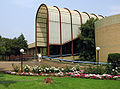
African Window

Paul Kruger's House
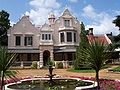
Melrose House


Musicedit
A number of popular South African bands and musicians are originally from Pretoria. These include Desmond and the Tutus, Bittereinder, The Black Cat Bones, Seether, popular mostwako rapper JR, Joshua na die Reën and DJ Mujava who was raised in the town of Attridgeville.
The song "Marching to Pretoria" refers to this city. Pretoria was the capital of the South African Republic (a.k.a. Republic of the Transvaal; 1852–1881 and 1884–1902) the principal battleground for the First and Second Boer War, the latter which brought both the Transvaal and the Orange Free State republic under British rule. "Marching to Pretoria" was one of the songs that British soldiers sang as they marched from the Cape Colony, under British Rule since 1814, to the capital of the Southern African Republic (or in Dutch, Zuid-Afrikaansche Republiek). As the song's refrain puts it: "We are marching to Pretoria, Pretoria, Pretoria/We are marching to Pretoria, Pretoria, Hurrah."
The opening line of John Lennon's Beatles' song I Am the Walrus, "I am he as you are he as you are me and we are all together", is often believed to be based on the lyric "I'm with you and you're with me and so we are all together" in "Marching to Pretoria". Lennon denied this, insisting his lyrics came from "nothing".
Performing arts and galleriesedit
Pretoria is home to an extensive portfolio of public art. A diverse and evolving city, Pretoria boasts a vibrant art scene and a variety of works that range from sculptures to murals to pieces by internationally and locally renowned artists. The Pretoria Art Museum is home to a vast collection of local artworks. After a bequest of 17th century Dutch artworks by Lady Michaelis in 1932 the art collection of Pretoria City Council expanded quickly to include South African works by Henk Pierneef, Pieter Wenning, Frans Oerder, Anton van Wouw and Irma Stern. And according to the museum: "As South African museums in Cape Town and Johannesburg already had good collections of 17th, 18th and 19th century European art, it was decided to focus on compiling a representative collection of South African art" making it somewhat unusual compared to its contemporaries.
Pretoria houses several performing arts venues including: the South African State Theatre which houses the arts of Opera, musicals, plays and comedic performances.
A 9 metre tall statue of former president Nelson Mandela was unveiled in front of the Union Buildings on 16 December 2013. Since Nelson Mandela's inauguration as South Africa's first majority elected president the Union Buildings have come to represent the new 'Rainbow Nation'. Public art in Pretoria has flourished since the 2010 FIFA World Cup with many areas receiving new public artworks.
Sportedit
One of the most popular sports in Pretoria is rugby union. Loftus Versfeld is home to the Blue Bulls, who compete in the domestic Currie Cup, and also to the Bulls in the international Super Rugby competition. The Bulls Super Rugby team, which is operated by the Blue Bulls, won the competition in 2007, 2009 and 2010. Loftus Versfeld also hosts the football side Mamelodi Sundowns.
Pretoria also hosted matches during the 1995 Rugby World Cup. Loftus Versfeld was used for some matches in the 2010 FIFA World Cup.
Association football is one of the most popular sports in the city. There are two football teams in the city playing in South Africa's top-flight football league, the Premier Soccer League. They are Mamelodi Sundowns and Supersport United. Supersport United were the 2008–09 PSL Champions. Following the 2011/2012 season the University of Pretoria F.C. gained promotion to the South African Premier Division, the top domestic league, becoming the third Pretoria-based team in the league. After a poor league finish in the 2015/2016 season, University of Pretoria F.C. were relegated to the National First Division, the second-highest football league in South Africa, in the 2016 Premier Soccer League promotion/relegation play-offs.
Cricket is also a popular game in the city. As there is no international cricket stadium in the city, it does not host any top-class cricket tournaments, although the nearby situated Centurion has Supersport Park which is an international cricket stadium and has hosted many important tournaments such as 2003 Cricket World Cup, 2007 ICC World Twenty20, 2009 IPL and 2009 ICC Champions Trophy. The most local franchise team to Pretoria is the Titans, although Northerns occasionally play in the city in South Africa's provincial competitions. Many Pretoria born cricketers have gone on to play for South Africa, including current captain AB de Villiers and T20 captain Faf du Plessis.
The Pretoria Transnet Blind Cricket Club is situated in Pretoria and is the biggest Blind Cricket club in South Africa. Their field is at the Transnet Engineering campus on Lynette Street, home of differently disabled cricket. PTBCC has played many successful blind cricket matches with abled bodied teams such as the South African Indoor Cricket Team and TuksCricket Junior Academy. Northerns Blind Cricket is the Provincial body that governs PTBCC and Filefelfia Secondary School. The Northern Blind Cricket team won the 40 over National Blind Cricket tournament that was held in Cape Town in April 2014.
The city's Sun Arena at Times Square hosted the NBA Africa Game 2018.
Places of worshipedit
Among the places of worship, they are predominantly Christian churches and temples : Zion Christian Church, Apostolic Faith Mission of South Africa, Assemblies of God, Baptist Union of Southern Africa (Baptist World Alliance), Methodist Church of Southern Africa (World Methodist Council), Anglican Church of Southern Africa (Anglican Communion), Presbyterian Church of Africa (World Communion of Reformed Churches), Roman Catholic Archdiocese of Pretoria (Catholic Church). There are also Muslim mosques and Hindu temples.
Jewish communityedit
 | This section needs additional citations for verification. (November 2019) (Learn how and when to remove this template message) |
Pretoria has a small Jewish community of around 3,000. Jewish citizens have been in Pretoria since its foundation in the 19th century and played an important role in its industrial and economic growth. A Mr. De Vries, the first Jewish inhabitant of Pretoria, was a prominent citizen and prosecutor, a member of the Volksraad and a pioneer of the Afrikaans language. Another famed Jewish Pretorian was Sammy Marks.
Other early Jewish settlers, many of them immigrants from Lithuania, were not as educated as De Vries and often did not speak Dutch, Afrikaans, or English. Many of them spoke only Yiddish and made a living as shopkeepers in the local retail industry. Most Jewish residents stayed neutral in the Second Boer War, though some joined the South African Republic army.
The first congregation was founded between 1890 and 1895, and in 1898 the first synagogue opened on Paul Kruger Street. A second synagogue, known as the Great Synagogue, opened in 1922. Both synagogues are no longer in operation, but a Reformed synagogue, Temple Menorah, opened in the early 1950s.
The Jewish community of Pretoria's golden age was in the early 20th century, when many Jewish sports clubs, charities, and youth groups flourished. After 1948, many Jews left for Cape Town or Johannesburg.
The synagogue on Paul Kruger Street was purchased by the government in 1952 to become the new home of the High Court where prominent opposition figures in the Anti-Apartheid Movement were tried, including Nelson Mandela, Walter Sisulu, and 26 others were prosecuted for treason from 1 August 1958 to 29 March 1961; the Rivonia Trial was held there in 1963–1964.
Two Jewish schools arose in Pretoria, the Miriam Marks School, which was founded in 1905, and the Carmel School, which opened in 1959. Only the second, currently also operating as a synagogue, remains. Pretoria's Reformed congregation shares a rabbi with the Johannesburg one, though the synagogue no longer operates and services take place in worshippers' private homes.
Buddhist communityedit
A Buddhist center, the Jang Chup Chopel Rigme Centre ("Center of Light") was founded in early January 2015 by Duan Pienaar or Gyalten Nyima (his adopted monastic name) in Waverley around Pretoria-Moot. Pienaar is the only Afrikaner ordained in the highly selective Tibetan Tantric Buddhist community in Bylakuppe, in southern India. His instructor Lama Kyabje Choden Rinpoche is the highest tantric master after the Dalai Lama. Pienaar, who studied Buddhist teachers for twenty years, spent two years in India.
Commerceedit
The city is a major commercial centre and an important industrial centre. Its main industries are iron and steel works, copper casting, and the manufacture of automobiles, railway carriages and heavy machinery.
Pretoria has a number of industrial areas, business districts and small home businesses. A number of chambers of commerce exist for Pretoria and its business community including Pretoriaweb, a business networking group that meets once a month to discuss the issues of doing business in Pretoria. The members of Pretoriaweb also discuss issues in various social media environments and on the website.
Coat of armsedit
The Pretoria civic arms, designed by Dr. Frans Engelenburg, were granted by the College of Arms on 7 February 1907. They were registered with the Transvaal Provincial Administration in March 1953 and at the Bureau of Heraldry in May 1968. The Bureau provided new artwork, in a more modern style, in 1989.
The arms were: Gules, on an mimosa tree eradicated proper within an orle of eight bees volant, Or, an inescutcheon Or and thereon a Roman praetor seated proper. In layman's terms : a red shield displaying an uprooted mimosa tree surrounded by a border of eight golden bees, superimposed on the tree is a golden shield depicting a Roman praetor. The tree represented growth, the bees industry, and the praetor (judge) was an heraldic pun on the name.
The crest was a three-towered golden castle; the supporters were an eland and a kudu; and the motto Praestantia praevaleat Pretoria. The coat of arms have gone out of favour after the City Council amalgamated with its surrounding councils to form the City of Tshwane Metropolitan Municipality.


Comments
Post a Comment