Cityscape

Pretoria is known as the "Jacaranda City" due to the approximately 50,000 Jacarandas that line its streets. Purple is a colour often associated with the city and is often included on local council logos and services such as the A Re Yeng rapid bus system and the logo of the local Jacaranda FM radio station.
Architectureedit
 Media related to Buildings in Pretoria at Wikimedia Commons
 Media related to
 Pretoria has over the years had very diverse cultural influences and this is reflected in the architectural styles that can be found in the city. It ranges from 19th century Dutch, German and British colonial architecture to modern, postmodern, neomodern, and art deco architecture styles with a good mix of a uniquely South African style.
Some of the notable structures in Pretoria include the late 19th century Palace of Justice, the early 20th century Union Buildings, the post-war Voortrekker Monument, the diverse buildings dotting the main campuses of both the University of Pretoria and the University of South Africa, traditional Cape Dutch style Mahlamba Ndlopfu (the President's House), the more modern Reserve Bank of South Africa (office skyscraper) and the Telkom Lukasrand Tower. Other well-known structures and buildings include the Loftus Versfeld Stadium, The South African State Theatre and the Oliver Tambo building which is the Headquarters of the Department of International Relations and Cooperation.
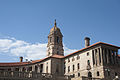
The Eastern Wing of the Union Buildings

Old Council Chambers, or Ou Raadsaal

Fort Klapperkop
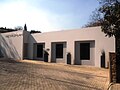
Neomodern architecture in Pretoria

The Palace of Justice


Central business districtedit
Despite the many corporate offices, small businesses, shops, and government departments that are situated in Pretoria's sprawling suburbs, its Central Business District still retains its status as the traditional centre of government and commerce. Many banks, businesses, large corporations, shops, shopping centres, and other businesses are situated in the city centre which is towered by several large skyscrapers, the tallest of which is the Poyntons Building (110 m or 360 ft tall), the ABSA Building (132 m or 433 ft tall) and the Reserve Bank of South Africa building (150 m or 490 ft tall).
The area contains a large amount of historical buildings, monuments, and museums that include the Pretoria City Hall, Pretorius Square, Church Square (along with its many historical buildings and statues), and the Ou Raadsaal. There is also the Transvaal Museum (the country's leading natural history museum, which although it has changed venues a number of times, has been around since 1892), the National Zoological Gardens of South Africa (or more colloquially known as the Pretoria Zoo), Melrose House Museum in Jacob Maré Street, the Pretoria Art Museum and the African Window Cultural History Museum.
Several National Departments also have Head Offices in the Central Business district such as the Department of Health, Basic Education, Transport, Higher Education and Training, Sport and Recreation, Justice and Constitutional Development, Public Service and Administration, Water and Environmental Affairs and the National Treasury. The district also has a high number of residential buildings which house people who primarily work in the district.
Parks and gardensedit
Pretoria is home to the National Zoological Gardens of South Africa, as well as the Pretoria National Botanical Garden. There are also a number of smaller parks and gardens located throughout the city, including the Austin Roberts Bird Sanctuary, Pretorius Square gardens, the Pretoria Rosarium, Church Square, Pretoria Showgrounds, Springbok Park, Freedom Park, Jan Cilliers Park and Burgers Park, the oldest park in the city and now a national monument. In the suburbs there are also several parks that are notable: Rietondale Park, "Die Proefplaas" in the Queenswood suburb, Magnolia Dell Park, Nelson Mandela Park and Mandela Park Peace Garden and Belgrave Square Park.
Jacaranda cityedit
 | This section relies largely or entirely on a single source. (November 2019) |
Pretoria's nickname "the Jacaranda City" comes from the around 70,000 jacaranda trees that grow in Pretoria and decorate the city each October with their purple blossoms. The first two trees were planted in 1888 in the garden of local gardener, J.D. Cilliers, at Myrtle Lodge on Celliers Street in Sunnyside. He obtained the seedlings from a Cape Town nurseryman who had harvested them in Rio de Janeiro, Brazil. The two trees still stand on the grounds of the Sunnyside Primary School.
The jacaranda comes from tropical South America and belongs to the family Bignoniaceae. There are around fifty species of jacaranda, but the one found most often in the warmer areas of Southern Africa is Jacaranda mimosifolia.
At the end of the 19th century, the flower and tree grower James Clark imported jacaranda seedlings from Australia and began growing them on a large scale. In November 1906, he donated two hundred small saplings to the Pretoria City Council, which planted them on Koch Street (today Bosman Street). The city engineer Walton Jameson, soon known as "Jacaranda Jim", launched a program to plant jacaranda trees throughout Pretoria, and by 1971 there would already be 55,000 of them in the city.
Most jacarandas in Pretoria are lilac in colour, but there are also white ones planted on Herbert Baker Street in Groenkloof.
The Jacaranda Carnival is an old tradition that was held from 1939 to 1964. After a hiatus of over twenty years, it resumed in 1985. Festivities include a colourful march and the crowning of the Jacaranda Queen.


Comments
Post a Comment